

What Is The Madisonian Model
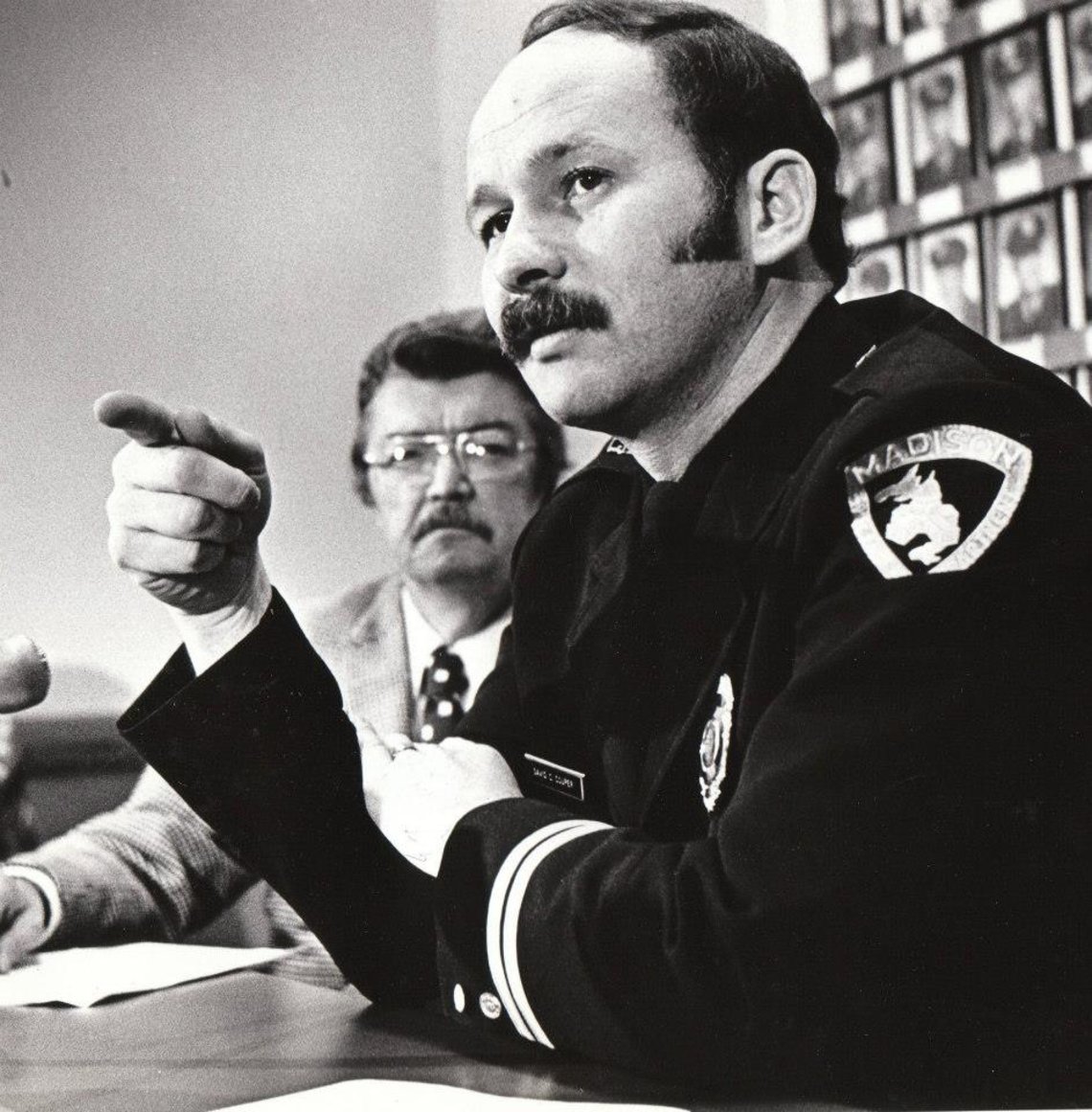
For 20 years, David C. Couper was the main of police in Madison, Wisc., the liberal Big Ten university boondocks that became a laboratory for his ideas about community policing and community engagement. During his tenure, from 1973 to 1993, Couper earned a reputation equally a progressive reformer at a time when the War on Drugs and "tough on crime" were law enforcement mantras.
His "Madison Model" pushed a theory that "police officers are substantially social workers in blue." He dressed officers in blazers and shorts, sending them to march peacefully alongside anti-Vietnam war protesters at the University of Wisconsin. He also set up neighborhood beats in Madison's high-criminal offense pockets and deployed officers to walk the streets. And he taught rookie officers that information technology was acceptable to avoid confrontations with an armed suspect, rather than fire their guns in volatile exchanges.
At present at the historic period of 77 and an Episcopal priest, Couper remains deeply engaged — and concerned — with how constabulary enforcement responds to new challenges. For Madison, at the moment, that means the death of Tony Robinson, a 19-year-old unarmed biracial homo, who was killed by a white policeman's bullets on March vi.
Dane Canton District Attorney Ismael Ozanne (who is likewise biracial) announced Tuesday that his role would not seek criminal charges confronting the officer, Matthew Kenny. The officeholder was responding to several 911 reports that Robinson was interim erratically, jumping in front end of cars and assaulting someone outside a restaurant. Toxicology tests constitute that Robinson had hallucinogenic mushrooms, marijuana, and Xanax in his system.
Kenny told his fellow officers that he had feared for his life during his brief see with Robinson and that the teenager, who was six feet 5 inches tall, had knocked him into wall. Kenney shot Robinson 7 times in less than 4 seconds and remains on administrative leave, awaiting an internal department review.
The Robinson case comes after months of national soul-searching over the employ of force by police officers. Police force action that led to the deaths of African-Americans in Ferguson, Mo., Staten Island, Cleveland, N Charleston, Due south.C., and Baltimore provoked prolonged and sometimes violent demonstrations. In Madison, the metropolis that gave rise to the Madison Model of de-escalation and less aggressive policing strategies, the same concerns are now front end and center.
Simply the Madison Model (also known every bit the "Madison Method,") has non, so far, faced any widespread criticism. In fact, as laid out in a Justice Department report from more than 20 years agone, it is still a go-to program relied on by law-enforcement consultants and community policing experts.
"It is O.Yard. to back off. It is O.One thousand. to de-escalate. It is O.K. to find improve alternatives; you don't have to exist and then quick to employ deadly force," Couper said in an interview.
Couper calls his overall approach to police force enforcement "autonomous policing." He bases his model on a diversity of policies that he implemented during his two-decades every bit Madison'south principal. The nigh popular of these involves policing protests, where officers are instructed to refrain from using force during mass demonstrations and are told to protect people first, belongings 2nd.
Madison's electric current chief, Michael C. Koval, reinforced the policy in a blog post this week, noting that the police department, although the target of the protesters' frustration, still wanted to award people's constitutional right to express themselves.
"They didn't put officers in hard body armor. They kept a respectful style," said Couper, who has marched with Robinson supporters.
Michael Masterson, a one-time police chief in Boise, Idaho, cited Madison's protest-policing style as part of his marketing strategy in efforts to concenter major conferences and other events to his city. Masterson, who one time was once a Madison law commander and, until stepping down in January, led the Boise department for a decade, touted Madison's lessons in a 2012 FBI bulletin virtually oversupply control. Boise hosted the Special Olympics and the National Governors' Briefing on Masterson's sentry.
"Managing crowds is one of the most important tasks police perform," Masterson wrote.
Madison'due south law-enforcement legacy is not just its response to mass demonstrations and protests. There is also a namesake model for patrolling loftier-crime neighborhoods, explained past Couper as "quality policing." Couper pushed quality policing during the 1980s and allowed beat out officers to make decisions nigh how to solve minor crimes without approval from a supervisor. He also instructed officers to exist more than "sensitive" towards residents' complaints and recruited more blacks and women to join the strength.
"It was a big chore. To have an all white male organization and have to diversify it. It was putting in a lifetime of piece of work," Couper said.
The common thread of Couper'south methods and models resides in teaching officers how to talk their mode out of a potentially violent situation, or de-escalation. (Madison'south use of force policy, notwithstanding, allows an officer, who believes he or she is in the midst of a life-threatening exchange, to kill someone without a verbal alarm.)
Couper'southward constabulary communication theory has also fabricated its fashion effectually to diverse other police force departments over the years.
James Ginger, a veteran police monitor who oversaw the Justice Department'south court-ordered police reform plan in Pittsburgh and is currently heading similar efforts in Albuquerque, said he threaded Couper's de-escalation tactics into the changes that he oversaw in Pittsburgh. Those reforms mandated that police recruits larn how to talk to obstinate people, such as those who demand that an officeholder prove identification, instead of resorting to violence.
"Dave Couper was the essential 'calm folks down, and let'due south talk about the state of affairs' guy," Ginger said in an interview.
Noble Wray, another former Madison primary, who was the 2d African-American to head the department, is now a Justice Department expert on bias in policing and travels the country — including St. Louis and Ferguson — instructing officers on how to avert unfairly stereotyping residents based on pare color or where they live.
"You have to communicate on a homo level. You make that man connexion. Respect and dignity is the foundation of being able to de-escalate," Wray said.
But there are those who see flaws with the Madison Model. Matthew Braunginn, a spokesman for the Madison-based advocacy grouping Young Gifted and Black Coalition, described the policing strategy as "soft oppression."
"Information technology was developed as a style to quell uprising, information technology wasn't some morality pick," Braunginn wrote in a text. Young Gifted and Black, inspired by the demonstrations in Ferguson, has organized a series of marches in Madison since Robinson'southward death. "It's a reform that'southward used to pacify and not accost the structural issues at play," Braunginn wrote.
The "structural issues" Braunginn referenced were highlighted in a 2013 report on racial disparity in Dane County — where Madison is located, 80 miles due west of Milwaukee. The college town is home to around a half-meg residents, and blacks make up six percent of the population. Statistical measures, based on race, show a articulate split.
For example, the charge per unit of adult arrests in Dane Canton for white residents was 36 out of 1,000 compared to 295 out of 1,000 for blacks. Median income for white households was $63,673 while blackness households earned a median income of $twenty,664. And 85 percent of white loftier school students graduated on time compared to 50 per centum of black students.
The Madison Model does not directly address deep-seated socio-economic issues. But inherent in Couper's original outline for policing is the need to be aware of an individual'south civil rights.
"The preservation of life, that'south our task,'' Couper said. "And that's the matter of leadership. That's a thing of preparation. Information technology's day-to-day policing. Nosotros are the lifesavers. That has to be integrated in the culture."

What Is The Madisonian Model,
Source: https://www.themarshallproject.org/2015/05/14/the-madison-model
Posted by: satterfieldgonofferand.blogspot.com
0 Response to "What Is The Madisonian Model"
Post a Comment