

Libyan Desert On A Map
Coordinates: 24°N 25°E / 24°N 25°E / 24; 25

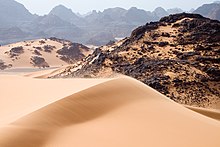
The Libyan Desert landscape east of the Gilf Kebir.
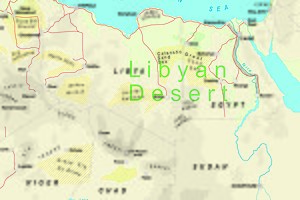
The Libyan Desert (not to exist dislocated with the Libyan Sahara) is a geographical region filling the north-eastern Sahara Desert, from eastern Libya to the Western Desert of Egypt and far northwestern Sudan. On medieval maps, its use predates today's Sahara, and parts of the Libyan Desert include the Sahara's most barren and least populated regions; this is chiefly what sets the Libyan Desert apart from the greater Sahara. The consequent absence of grazing, and well-nigh absence of waterholes or wells needed to sustain camel caravans, prevented Trans-Saharan trade betwixt Kharga (the Darb al Arbein) shut to the Nile, and Murzuk in the Libyan Fezzan. This obscurity saw the region overlooked by early European explorers, and information technology was not until the early on 20th century and the advent of the motor car before the Libyan Desert started to be fully explored.
Nomenclature [edit]
The term 'Libyan Desert' began to appear widely on European maps in the last decades of the 19th century, typically identified equally straddling the borders of present-day Egypt and Libya. This name derived from a territory known equally Aboriginal Libya. (It was not until 1934 that one-time Ottoman Tripolitania became known every bit Libya.) In his book Libyan Sands, Ralph Bagnold went as far equally to advise that the Libyan Desert was a separate geographical entity from the Sahara, cut off by the mountains and plateaux of the Ennedi and Tibesti in northern Chad, and the Akakus and Tassili northward'Ajjer along the Algerian border in the due west. Since that fourth dimension the meaning has come up to revert to the definition given above.
Geography [edit]
The Libyan Desert covers an area of approximately 1,300,000 square kilometres (500,000 sq mi), and extends approximately ane,100 km from east to west, and 1,000 km from north to south, in about the shape of a rectangle slanting to the south-e. Like most of the Sahara, this desert is primarily sand and hamada or stony plain.
Sand plains, dunes, ridges, and some depressions (basins) typify the endorheic region, with no rivers draining into or out of the desert. The Gilf Kebir plateau reaches an altitude of simply over i,000 grand, and along with the nearby massif of Jebel Uweinat is an exception to the uninterrupted territory of basement rocks covered by layers of horizontally bedded sediments, forming a massive sand plain, low plateaus, and dunes.[i]
The desert features a striking variety of landscapes including mountains, oases, and sand seas.
To the south lie the main mountain ranges, from the Jebel Uweinat (1,980 thousand), on the Libya-Egypt-Sudan border, the Tibesti to the south, on the border with Chad, and the Acacus to the southwest. The main oases are Jaghbub and Jalo in east, in Cyrenaica, Kufra in the southeast, and Murzuk in the southward, in Fezzan. The sand seas lie in a band effectually the border of Libya. To the e lies the Calanshio Sand Body of water, the western lobe of the Great Sand Sea straddling the Libya-Egypt edge, and stretches 800 kilometres from Jaghbub and Jalo in the north to Kufra in the south. To the south-eastward lies the Rebiana Sand Sea, near the edge with Sudan. To the s west is the Idehan Murzuq, bordering Chad, and to w lies the Idehan Ubari, adjoining Algeria. The sand seas comprise dunes upward to 512 meters in top, and cover approximately one quarter of the total desert region.
Other features are the Aswad al Haruj (the "Black Desert"), a large circular region of black volcanic shield in the centre of the country, and the Hamada al Hamra (the "Red Desert") a rocky plateau to the westward, on the Tunisian border, coloured by iron oxide deposits. To the southeast, between Kufra and the Libya-Egypt-Sudan border, lies the Jebel Arkenu, with the associated Arkenu structures, thought to be caused by meteorite strikes.[1] Due north of the Gilf Kebir plateau, among the shallow peripheral dunes of the southern Great Sand Sea, is a field of Libyan desert glass. This is thought to be associated with a meteorite affect, marked past the Kebira crater, on the Libya-Egypt border. A specimen of the desert drinking glass was used in a piece of Tutankhamun's ancient jewellery.
The Libyan Desert is barely populated apart from the modern settlements at oases of the lower Cyrenaica region in southeastern Libya. The ethnic population are Bisharin tribe, Mahas, and Berber. Where the desert extends into Egypt and no longer in Libya, information technology is generally known as the "Western Desert". The term "Western Desert" contrasts with the Eastern Desert to the east of the Nile River, which lies between the Nile and the Red Sea.
Climate [edit]
The Libyan desert is said to be ane of the to the lowest degree hospitable regions on World. Its climate is surprisingly variable, being hot in summer, with average daytime temperatures of l °C (122 °F) and above, though this drops rapidly at dark. In winter, days are cool, with temperatures averaging 27 °C (81 °F), simply at night this can drop below freezing, with temperatures of −nine °C (16 °F) recorded. At these times the formation of hoar frost is not uncommon, and are known as "White Nights". Contrariwise, at 'Aziziya a daytime temperature of 58 °C (136 °F) was seen in 1922, the highest naturally occurring temperature on tape.[2]
In the n, along the Mediterranean shore, cool onshore winds blow inland, while farther south, hot, dry out winds, known as Ghibli, blow from the interior, creating blinding sand-storms. Periodic droughts are common in the desert, ofttimes lasting several years.[3]
History [edit]
Historical desert [edit]

Historically, "Libya" referred to an ill-defined area to the west of Ancient Arab republic of egypt, whose boundary traditionally was the lake of Mareotis, exterior Alexandria. The ancient Greeks, such as Herodotus, regarded the whole of the N African coastal, to Greatcoat Spartel in Morocco, equally "Libya". After, the Romans organized the region the provinces of Libya Inferior and Libya Superior, which covered western Arab republic of egypt and Cyrenaica. Thus the "Libyan Desert" was the desert to the south of Ancient Libya. With the arrangement of the Italian colony of Libya in the 20th century the term "Libyan Desert" for this region became a misnomer, and the area of desert within Egypt became known as the "Western Desert" (i.e. west of the Nile, in contradistinction to the Eastern Desert, east of the Nile).[4]
Earth War I [edit]
Following the conquest of the territory by Italy during the Italo-Turkish War of 1911–12, the desert became the scene of a 2-decade struggle between the Italians and the Senussi starting from 1915,[5] who were centred on the Jebel Akhdar in Cyrenaica and on the Kufra oasis. It ended in 1931 with the conquest of Kufra by the Italians.
Modern exploration [edit]
During the 1930s the Libyan desert was the scene of exploration and mapping by the Italian Ground forces and Air Force. Others, such as Ralph Bagnold and Laszlo Almasy also travelled in south-eastern Libya and southern Egypt, searching for the lost haven of Zerzura. Bagnold likewise travelled into northern Republic of chad, to the Mourdi Depression, recording his findings in his book Libyan Sands: Travel in a Dead Globe, which was published in 1935.
Earth War Two [edit]
During the 2nd World War the n-eastern desert between El Agheila and the Egyptian border was the scene of heavy fighting between the Axis powers and the Western Allies, a catamenia known as the Western Desert Campaign. The deep desert saw operations by the Italian Car-Saharan Companies, in gainsay with the Allied Long Range Desert Group (LRDG) and the Gratis French Régiment de Tirailleurs Sénégalais du Tchad (RTST). Other actions included the Siege of Giarabub (now Jaghbub), the battle of Kufra and the raid on Murzuk, all in 1941.[6]
The Calanshio Sand Ocean is the site of the missing World War II aircraft Lady Exist Good. The wreck was discovered 200 km (120 mi) due north of Kufra 15 years after it was reported missing in 1943.
Meet also [edit]
- Algerian Desert
- Nubian Desert
References [edit]
- ^ a b The Libyan Sahara at temehu.com
- ^ de Villers p85
- ^ "Great socialist people's libyan arab jamahiriya - Climate | Britannica". www.britannica.com . Retrieved 2022-ten-31 .
- ^ Pitt p13
- ^ Banks, Iain (2007-11-01). "Ghosts in the Desert: the Archaeological Investigation of a Sub-Saharan Battlefield". Journal of Disharmonize Archaeology. 3 (1): 6. doi:10.1163/157407807X257340. ISSN 1574-0773.
- ^ Pitt pp235-240
Farther reading [edit]
- Pitt, Barrie: The Crucible of War: Western Desert 1941 (1980) Jonathan Cape ISBN 0 224 01771 three
- Andrew Goudie, Keen Warm Deserts of the Globe (2002) OUP ISBN 0 199 24515 0
- Ralph Bagnold, Libyan Sands: Travel in a Dead Earth (2010) Eland ISBN 1 906 01133 8
- Theodore Monod, Désert libique (1994) Arthaud ISBN 2 7003 1023 3
- Ahmed Hassanein Bey, The Lost Oases (2006) AUCP ISBN 978-1590481462
- László Almásy, Ismeretlen Szahara (Unknown Sahara) (1934) English language pdf at fjexpeditions.com
External links [edit]
- The Libyan Desert at fjexpeditions.com
- Libyan Desert at African volunteer.net; retrieved 6 November 2016
- The complete text and photos of the discoveries of Ahmed Pasha Hassanein in the Libyan Desert, National Geographic Magazine, September 1924
- Gilf Kebir, Uweinat and the Great Sand Sea

Libyan Desert On A Map,
Source: https://en.wikipedia.org/wiki/Libyan_Desert
Posted by: satterfieldgonofferand.blogspot.com
0 Response to "Libyan Desert On A Map"
Post a Comment